
Press room: Making Sense of Cybersecurity
Journalists, podcasters, and event organisers can find everything about Making Sense of Cybersecurity on this page: a fact sheet, author bios in three lengths, cover and photo downloads, interview questions, and story ideas. I'm happy to talk about the book, about my work as a CISO and consultant, and about any cybersecurity story that your readers need explained without the jargon. Review copies are available to journalists, and I send them myself.
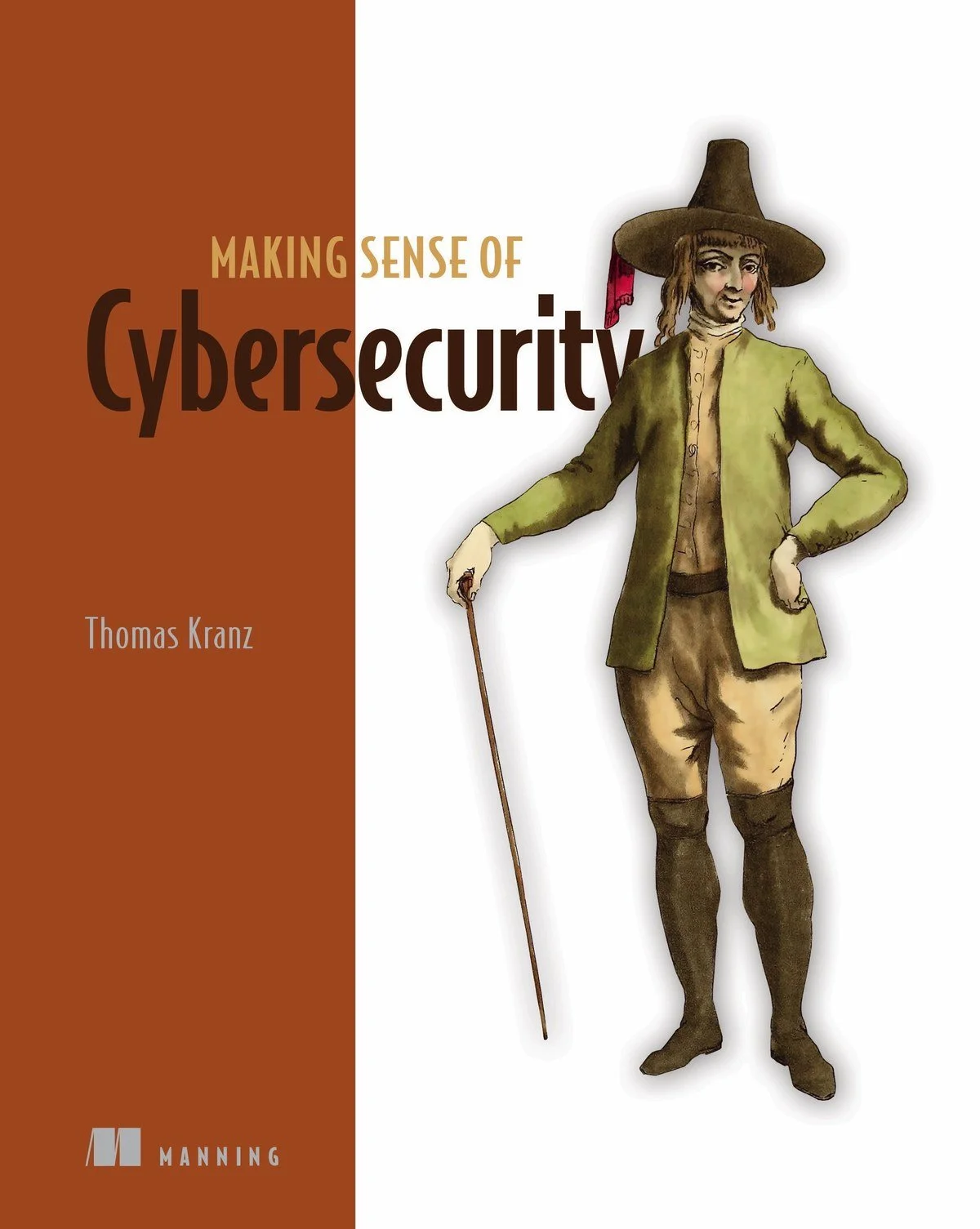
Fact sheet
| Title | Making Sense of Cybersecurity |
| Author | Thomas Kranz (Tom Kranz) |
| Foreword | Naz Markuta |
| Publisher | Manning Publications |
| Published | October 2022 |
| ISBN | 9781617298004 |
| Pages | 288 |
| Copies sold | Over 8,000 |
| Formats | Print and e-book |
| Language | English |
| Subject | Cybersecurity for business and technical readers with no IT background |
| Readers | Executives, project managers, team leads, and developers |
| Awards | Bronze award, Axiom Business Book Awards 2023, Business Reference category. Official selection, Business Book Awards 2023. |
| Author honours | Gold Globee Winner, Cybersecurity Consultant of the Year, March 2023 |
| Ratings | 5.0 on Amazon (8 reviews), 4.8 on Manning, 4.08 on Goodreads (November 2026). More on the praise page. |
| Where to buy | Manning |
| Review copies | Available to journalists. Email tom@tomkranz.com. |
What the book covers
Part 1 explains how attackers think and walks through the attacks they use most, including SMS authentication, physical security, USB and access-card attacks, rogue WiFi, social engineering, and the Dark Web. Part 2 covers risk, threat models, testing, the security operations centre, protecting people, and responding after a hack.
The book builds a strategy on three pillars: it must be relevant, proportional, and sustainable. It also teaches the OODA loop and a hacker mindset as working tools for people who've never touched a command line.
About the author
Short (about 50 words)
Thomas Kranz is an award-winning cybersecurity consultant, a CISO, and the author of Making Sense of Cybersecurity (Manning, 2022), which won a Bronze award at the Axiom Business Book Awards 2023. He has more than 30 years of experience in IT and cybersecurity, and he's a Gold Globee Winner for Cybersecurity Consultant of the Year.
Medium (about 100 words)
Thomas Kranz is a CISO and award-winning consultant with more than 30 years of experience in governance, risk, compliance, and security. He has delivered security programmes and regulatory compliance strategies in high-risk environments, worked with financial and government regulators across the EU, and achieved ISO27001 and SOC2 certification for clients in financial services, insurance, automotive and manufacturing, and consulting. His book Making Sense of Cybersecurity (Manning, 2022) won a Bronze award at the Axiom Business Book Awards 2023, and he's a Gold Globee Winner for Cybersecurity Consultant of the Year (March 2023). He also wrote How Is AI Transforming Cybersecurity? for NVIDIA.
Long (about 200 words)
Thomas Kranz is a CISO, consultant, and author with more than 30 years of experience in IT and cybersecurity, from sysadmin through to the boardroom. He started hacking on a BBC Micro in the 1980s, and his clients have included UK government departments and private-sector firms across financial services, insurance, automotive and manufacturing, and consulting.
He has delivered security programmes and regulatory compliance strategies in high-risk environments, led government security transformation programmes, achieved ISO27001 and SOC2 certification for regulated clients, and managed data governance and GDPR compliance. He has worked with financial and government regulators across the EU, and he has given evidence to UK and EU government working groups and committees on digital ID, encryption, surveillance, and privacy.
His book Making Sense of Cybersecurity (Manning, 2022, foreword by Naz Markuta) won a Bronze award at the Axiom Business Book Awards 2023 in the Business Reference category, and it was an official selection of the Business Book Awards 2023. In March 2023 he was named Gold Globee Winner for Cybersecurity Consultant of the Year. He also wrote the NVIDIA e-book How Is AI Transforming Cybersecurity? (2023), and he's now writing Making Sense of AI in Cybersecurity and Making Sense of DORA.
Tom is British, holds Latvian citizenship, and lives in northern Italy.
Download all three bios as plain text
Downloads
Free to use in coverage of the book. Please keep the credit line with each file.
Credit: Thomas Kranz
Credit: Manning Publications
Credit: Manning Publications
Credit: Manning Publications
Credit: Thomas Kranz
Interview questions
You tell readers that everyone will get hacked at some point. What do you say to a board that hears that and decides there's no point spending money?
The book teaches the OODA loop and a hacker mindset. How does a non-technical manager use either one on a Monday morning?
Why does the book spend a whole chapter on social engineering, and what's the attack that people still fall for most often?
You write about SMS authentication and physical attacks like malicious USB chargers. Why do companies still ignore them?
What does "relevant, proportional, and sustainable" mean for a 200-person company with one part-time security person?
Is the Dark Web as dangerous as the headlines say, and does a business need to care about it?
You've said people are both the weakest link and the most valuable asset. How do you build a culture where staff report a mistake and don't hide it?
What should a company do in the first hour after it finds out it has been hacked?
The book came out in October 2022. What has changed since then, and what has stayed exactly the same?
You're now writing about AI in cybersecurity and about DORA. What's the connection with this book?
Story ideas
Why a company's patching policy matters more than the shiny security product it bought, with the CVE and CVSS scoring systems explained in plain English (Chapter 2).
How hackers think, and how a developer's mindset differs from an attacker's, with the four questions an attacker asks of any new system (Chapter 3).
Rogue WiFi, SMS interception, and malicious USB chargers, and the cheap fixes that work (Chapters 4 and 5).
Insider threats and what to do when an employee leaves, including privilege escalation and the advanced persistent threat (Chapter 6).
A plain-English tour of the Dark Web, why the book describes several separate Dark Webs, and how stolen data gets traded (Chapter 7).
Bug bounties, penetration tests, and red teams, and how a company chooses the right one for its size (Chapter 9).
Why blame cultures make breaches worse, and what a security champion does (Chapter 11).
What to do after a hack, including the NIST incident response model and how to borrow Agile retrospectives to learn from it (Chapter 12).
Contact
Press, interview, and review-copy requests: tom@tomkranz.com. To book a call: https://calendly.com/tomkranz. For articles, talks, and expert comment, see the press page. Weekly newsletter: Ambulance Chasing.